.jpg)
.jpg)


Annunciatie


Missaal
Wencesclas, Hertog en Martelaar
28 september
Deze Boheemse prins werd door zijn heidense broer Boleslas op bevel van zijn wrede moeder in de kerk gedood omstreeks 930.
Stijn
van der
Linden
Wencesclaus I van Bohemen Kleinzoon van St Ludmilla van Bohemen, die hem christelijk opvoedde. Vanaf 922 hertog van Bohemen. Werkte aan de kerstening en culturele verheffing van zijn volk. Werd vermoord door zijn moeder Drahomira en zijn broer en tegenstander Bolelkav I (de verschrikkelijke) bij de deur van de St-Cosmas-en-Damianuskerk van Stará Boleslav aan de Elbe (noordoostelijk van Praag). Relieken (helm, harnas en zwaard) bevinden zich in de St-Vituskathedraal van Praag. Hij geldt als de nationale heilige van de Tsjechen.
Ca 907 Stochov – 28 september 929 Stará Boleslav
Het later over hem geschreven lied De goede koning Wenceslaus (Good King Wenceslas, een Engels kerstlied dat dateert uit 1853) bevat slechts fictieve feiten. De moralistische tekst gaat over goede daden van Wenceslaus de Heilige, in het Engels Wenceslas, die met zijn page in de snijdende kou eten en brandhout naar een arme sloeber brengt. De tekst en de muziek rusten op uiteenlopende Midden-Europese tradities.
Patronaten
&
Iconografie
Patroonheilige van Slowakije en Tsjechië; van bierbrouwers.
Eerst afgebeeld als jonge hertog met handkruis of scepter en zwaard. Vanaf ongeveer 1085 als koning met baard en met de lans van de Duitse hertogen. Rond 1190 komt hier het schild met de adelaar bij. Vaak samen afgebeeld met andere patroonheiligen van Tsjechië, zoals St Adalbertus en St Vitus.
September 28
ST. WENCESLAS,
Martyr
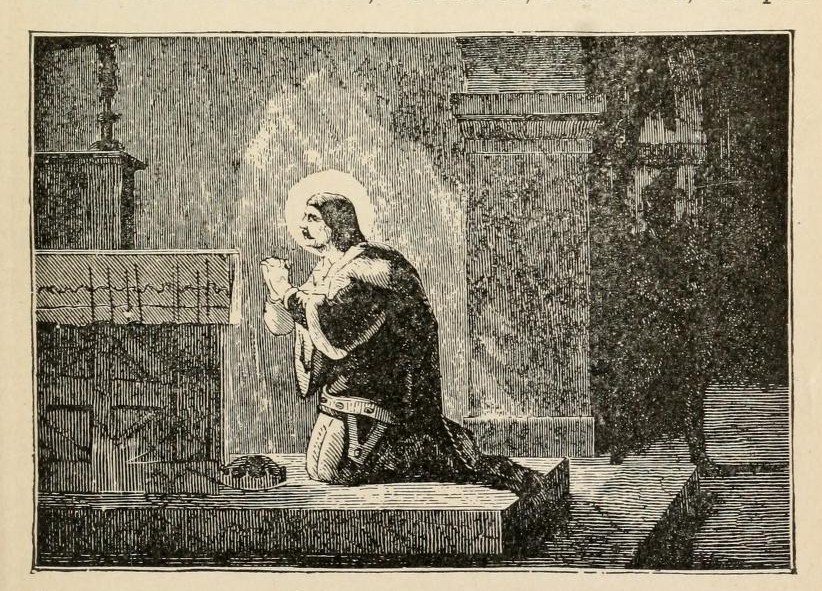
Wenceslas was the son of a Christian Duke of Bohemia, but his mother was a hard and cruel pagan. Through the care of his holy grandmother, Ludmilla, herself a martyr, Wenceslas was educated in the true faith, and imbibed a special devotion to the Blessed Sacrament. On the death of his father, his mother, Drahomira, usurped the government and passed a series of persecuting laws. In the interests of the Faith Wenceslas claimed and obtained, through the support of the people, a large portion of the country as his own kingdom.
His mother secured the apostasy and alliance of her second son, Boleslas, who became henceforth her ally against the Christians. Wenceslas meanwhile ruled as a brave and pious king, provided for all the needs of his people, and when his kingdom was attacked, overcame in single combat, by the sign of the cross, the leader of an invading army. In the service of God he was most constant, and planted with his own hands the wheat and grapes for the Holy Mass, at which he never failed daily to assist.
His piety was the occasion of his death. Once, after a banquet at his brother's palace, to which he had been treacherously invited, he went, as was his wont at night, to pray before the tabernacle. There, at midnight on the feast of the Angels, a.d. 938, he received his crown of martyrdom, his brother dealing him the death-blow.
Neem een gratis abonnement op de nieuwsbrief en ontvang een dagelijkse update!.


